Classic Kimono
by Katsunori Hamanishi
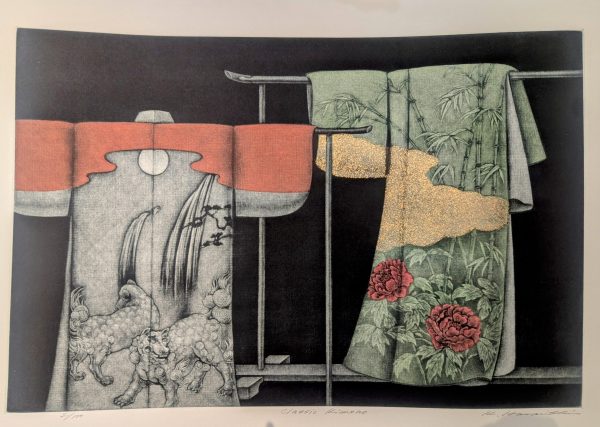
The Artist States:
Traditional Japanese houses are divided by shoji screens and sliding doors, so there is
little room on which to display paintings. Clothes racks are not only used as practical items for hanging clothes, but also as decorative furniture for hanging kimonos to brighten up a colorless room. For this reason, kosode kimonos with colorful flowers of auspicious patterns such as pine, bamboo, plum, crane, and turtle were well received. The pattern of the Chinese lion and peony depicted in Classic Kimono is an auspicious theme that has often been used in paintings such as folding screens and sliding doors in Japan and China, as well as in kabuki performances. It is said that it was born from a story in which the dew that accumulates on the peony flower was used as medicine to exterminate insects that parasitize the lion. The combination of the lion, the king of beasts, and the peony, the gorgeous kind of flowers, is a symbol of good fortune.
As for the technique, I used an aluminum plate to add color and gold clouds to the main plate of the copper plate mezzotint technique. First, I mixed about 70% of Graphiccemical’s Etching Ink, Bone Black, and about 30% of the highly adhesive Litho Black ink to make the main plate for mezzotint, and printed it on Japanese printmaking paper, Ardebaran. I waited for the ink to dry completely and then started printing the color and gold clouds. I used an aluminum plate for lithography that I had previously used for lithograph works as a cutout plate for the necessary parts and shapes with a cutter knife. I applied a thin layer of ink to these plates with a rubber roller and printing over them in relief printing format. Regular ink is very adhesive, and it affects the details of the printed mezzotint, so I needed an ink with low adhesiveness. For this reason, I used oil-based paint with some of the drying oil (medium) removed instead of ink. Compared to ink, oil paints have a wide variety of colors and good color development, making them a suitable art material. Depending on the type of paint, transparent medium may be added. To make the colors of this kimono more vibrant, I added a little mica powder, which is used in mica printing in woodblock prints. For the final gold clouds, also known as Suyari-kasumi, I used aluminum plates, just like the colors. I used transparent medium for lithography as an adhesive, and sprinkled gold sand on it before it dried. I mixed some copper sand into the gold sand to give the Suyari-Kasumi in this work some variety. This Classic Kimono was created not only regular mezzotint techniques, but also letterpress printing, aluminum plates used in lithography, and mica printing (Kirazumi) that has been tried in ukiyo-e, etc. It would be my greatest honor as an artist to have everyone enjoy the festive atmosphere of the auspicious “Karajishi and Peony” in their rooms.
Katsunori Hamanishi was born in 1949 in Hokkaido, Japan. He graduated in art from Tokai University and studied at the University of Pennsylvania. He was visiting artist at the Cleveland Art Institute, he taught at the University of Alberta, Yokohama College, Bradley University and others. He has won many prizes including the Ibiza Graphics, Yamamoto Print Exhibition and has been included in exhibitions at the Smithsonian, Sint-Niklaas Museum in Belgium, Art Institute of Chicago, and 20 other international venues. His work is in over 40 major collections worldwide including the Metropolitan Museum of Art, Museum of Modern Art, Cleveland Museum of Art, British Museum, National Museum of Art in Osaka, National Museum in Krakow, and Pushkin State Museum. His studio is in Kanagawa, Japan.
Timothy Kragt, Chairman Print Selection Committee.